

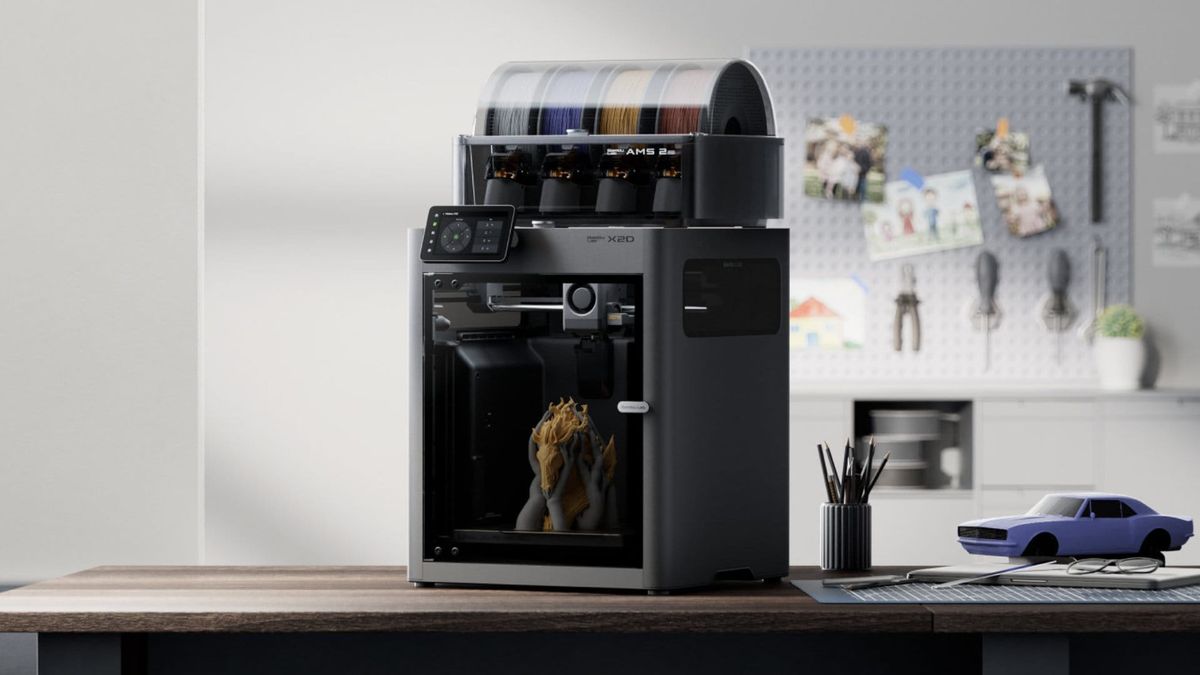


The Bambu Lab X2D landed in April 2026 at $649 — $100 more than the P1S, and arguably the most consequential printer release for small collectible studios since the original X1 Carbon. We've been printing on a P1S since day one of Geeky Inc, and the X2D forced us to rewrite the math on what a one-person collectible drop actually costs to produce. Here's what changed.
The Creator-Economics Problem in 2026
If you've tried to launch a collectible figure line in the last two years, you already know the squeeze. The audience wants articulated, hand-painted, multi-color figures that arrive in a real box with real packaging. The economics want you to ship cheap, fast, and at volume.
For a one-person studio printing in-house, that gap used to swallow most weekends. Single-nozzle FDM means every color change is either a manual pause-and-swap or an AMS purge tower that eats more filament than the figure itself. A two-color articulated chibi can lose 40–60% of its filament budget to waste on an AMS-only rig. That's not a rounding error — it's the difference between a sustainable margin and a hobby that costs you money.
The X2D is the first printer at the consumer price tier that takes a real swing at that problem.
What the Bambu X2D Actually Does Differently
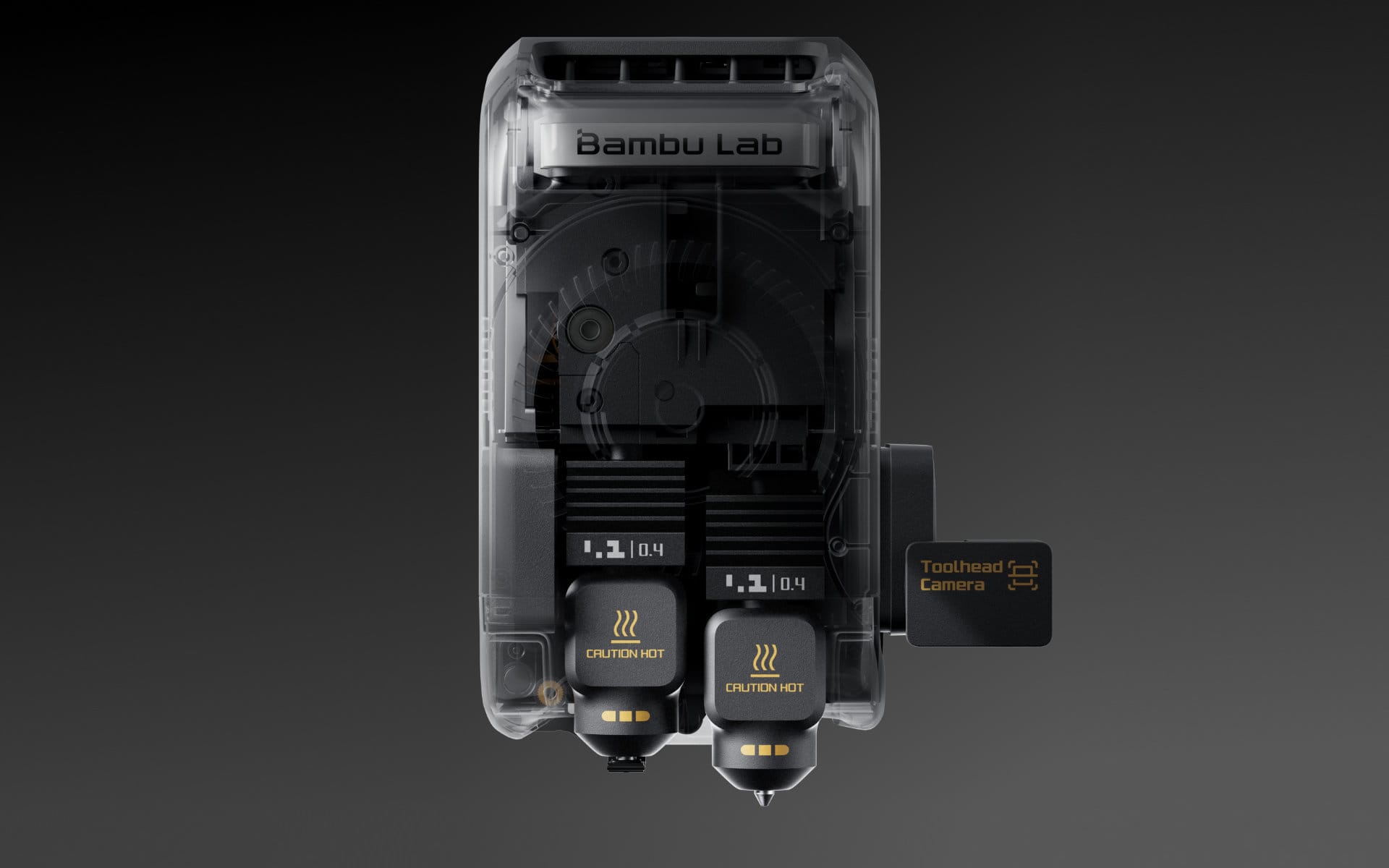
The headline spec is the dual-nozzle system, but the real story is which nozzle does what. The X2D pairs a direct-drive left nozzle with a Bowden-fed right nozzle inside a CoreXY frame. Left handles your primary material — including flexibles like TPU, which the right nozzle can't run. Right handles your secondary color or your soluble support, capped at 200 mm/s.
The other specs you need to know:
- Build volume: 256 × 256 × 256 mm (identical to P1S and X1 Carbon)
- Top speed: 500 mm/s with 20,000 mm/s² acceleration
- Nozzle temp: 300°C — handles every common engineering material
- Heated chamber: Active to 65°C, with dedicated heating element (not passive)
- Vision Encoder: 50-micron accuracy across the full bed
- Sound: Under 50 dB in Silent Mode, with Active Motor Noise Canceling
- Price: $649 standalone / $899 Combo with AMS
Bambu's own PLA Basic spools are still the safest filament for the dual-nozzle setup — color-matched, dialed-in profiles, and the cheapest way to start.
Why Multi-Material Matters for Anime & Gaming Figures
Single-color FDM figures look exactly like what they are — a 3D-printed prototype someone is selling on Etsy. Multi-color, soft-touch, and articulated changes the entire perceived tier. A two-tone fox spirit with a contrasting tail mod, or a chibi warrior with a separate-color sword and cape, jumps from "maker output" to "product."
The X2D's dual-nozzle architecture cuts purge waste 70–80% compared to AMS-only multi-material, which Bambu has confirmed in their own marketing and which independent reviewers including Tom's Hardware and TechRadar have validated in production runs. For a small studio doing two-color drops, that's not a marginal saving — it's the entire margin.
Combine that with the active 65°C heated chamber and you also get clean ABS and ASA prints without the warp tax. That matters the moment your figures need to survive a few weeks on a sunny shelf or a hot mailbox.
From One Printer to a Print Farm: When You Outgrow a P1S
We still print on a Bambu Lab P1S as the workhorse for the Geeky Inc figure line. It's the single best $549 you can spend if you're starting from zero. Articulated print-in-place models, anime-leaning aesthetic, packaged drops — the P1S handles all of it without complaint.
The P1S stops being the right answer when:
- You want true two-color characters without an AMS purge tower eating half your filament
- You want to print supports in a different material that snap off without scarring the figure
- You need ABS/ASA/PC for engineering parts (display stands, packaging jigs, custom shipping inserts)
- You're running a print farm and you want every node to do twice the work without doubling the floor space
The P1S is the entry. The X2D is the upgrade that lets a one-person studio look like a five-person one.
The Real Cost-Per-Pack Math
Here's the rough math we use for our blind-pack drops, printed on a P1S today and what it would shift to on the X2D for two-color figures:
P1S, single-color articulated chibi (45g final part, ~50g spool consumed): roughly $1.10 in filament at $22/kg.
P1S + AMS, two-color articulated chibi (45g final, ~80g spool consumed with purge tower): roughly $1.75 in filament. Color change wins, waste ratio loses.
X2D, two-color articulated chibi (45g final, ~52g consumed with smart purge): roughly $1.15. You get the multi-color win without the waste tax.
Spread that across a 100-pack drop and the X2D saves you about $60 in filament alone, plus several hours of post-processing. Across a year of monthly waves, that's a $700+ direct margin gain — half the printer paid back on filament savings before you account for the speed and quality improvements.
This is the math behind why we're printing the next Geeky Inc wave on a different rig than our first one.

What the X2D Won't Fix
The dual-nozzle setup isn't magic. A few honest limitations:
- The right nozzle is Bowden. Don't run TPU through it. Flexibles go through the direct-drive left side, which means your primary material has to be the flexible one if you want a soft-touch figure.
- 200 mm/s ceiling on the right nozzle. Two-color prints are slower than single-color X2D prints, full stop. The X2D's headline 500 mm/s number assumes single-nozzle work.
- Same 256³ build volume as the P1S. If you wanted a bigger bed, the X2D isn't your printer — that's a Bambu H2D conversation.
- $649 is still $649. The X2D is great. It is not the printer you buy first if you've never run a Bambu before. Start on the P1S, prove your designs sell, then upgrade.
Should You Buy It?
Three filters:
Buy the X2D if: you're already running a P1S or X1 Carbon, your designs need two colors or soluble support, and you want production-quality output without a print farm. Tom's Hardware named it Best 3D Printer Overall 2026 for a reason — it earns the title in dual-material work specifically.
Buy the P1S instead if: you're new to Bambu, your designs are single-color, and you'd rather invest the $100 difference into filament, a spare build plate, and a good set of calipers. You'll grow into the X2D later.
Wait for the H2D if: your designs need a bigger bed or more than two materials in the same print. The H2D is a different tier of machine for a different tier of buyer.
For a one-person collectible studio in 2026, the X2D is the first printer at this price that actually changes the unit economics. Not by a little. By the kind of margin that lets you fund the next wave from the proceeds of the last one — which is the only sustainable way any of this works.
The Bottom Line
Geeky Inc's chibi figures print on a P1S because the designs are single-color articulated models and the P1S handles them perfectly. The X2D is for the two-color humanoid warrior line we're building, where the contrasting accent colors are the entire visual identity.
If you're a maker who wants to sell figures and you've been waiting for the printer that doesn't force you to choose between margin and quality, this is it.
Image credits: Bambu Lab US, Tom's Hardware (X2D review), TechRadar, All3DP.
Related reading: If you're cross-shopping the X2D against Bambu's flagship multi-material machines, our Bambu Lab H2D vs H2C vs X2D: Full Comparison (2026).
Wave 1 — Kitsune Legends Vol. 1
Wave 1 is live.
Four hand-printed fox-spirits. One sealed box. You don't choose your kitsune — you summon it. Limited run, no restock.
Summon your Kitsune on Etsy →


Member discussion