


The debate between Prusa XL's tool-changer system and Bambu's AMS has been going on since 2023, and in 2026 it's still one of the most genuinely contested questions in FDM printing. Both approaches produce multi-material prints. Both have real tradeoffs. And for a specific use case — printing anime figures, gaming props, articulated collectibles — the answer is clearer than most reviews will tell you.
Bambu also expanded the conversation in 2026 with the H2C (Vortek) and the new H2D, both of which take direct aim at AMS waste while keeping Bambu's speed advantage. We'll fold them into the verdict at the end. (For a full Bambu-internal breakdown of the H2D, H2C, and X2D, see our Bambu X2D vs H2D vs H2C comparison.)
Let's break it down without brand allegiance.
How Each System Works
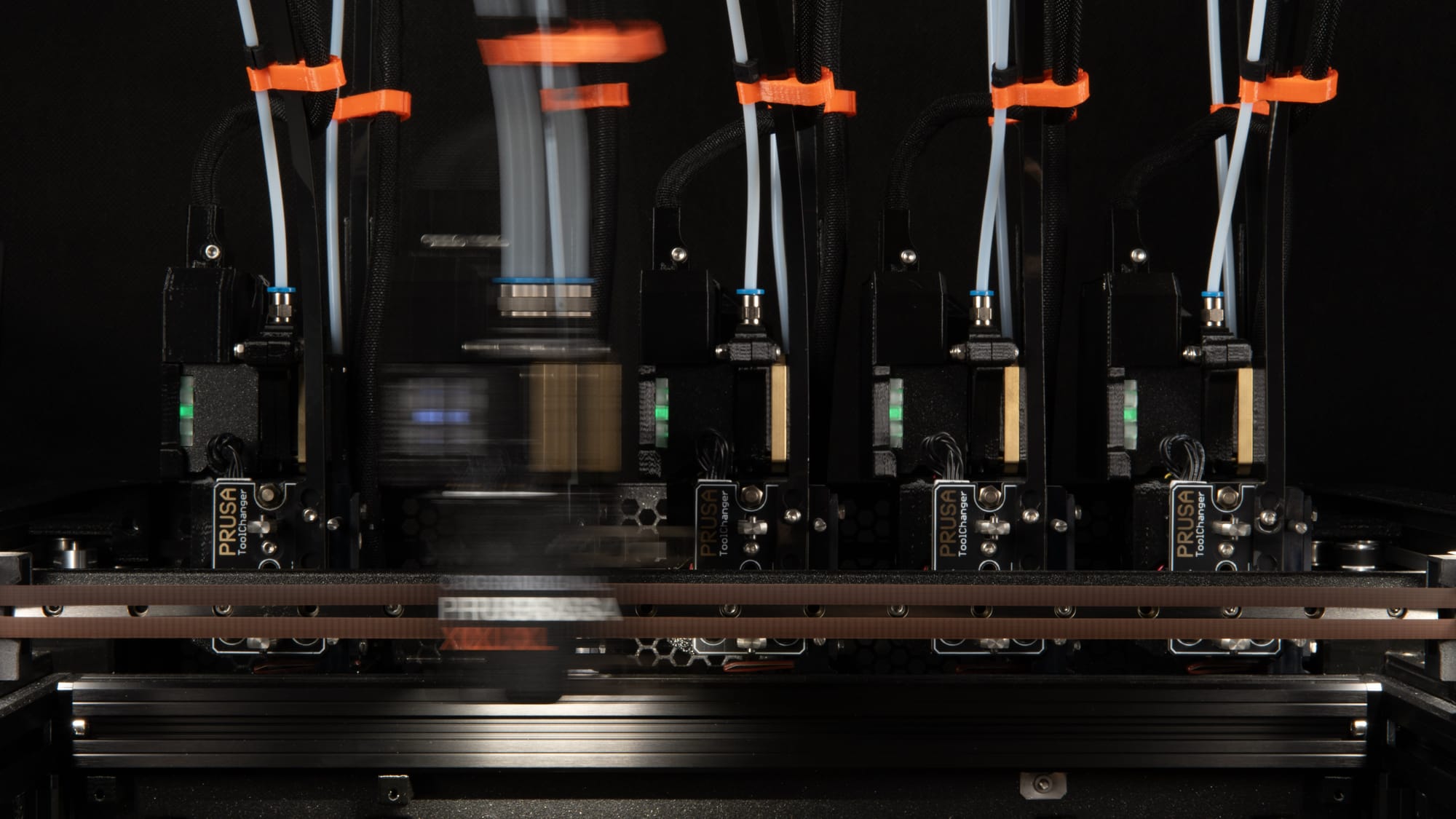
Prusa XL (Tool Changer): The XL physically swaps entire toolheads during a print. Each toolhead is its own independent extruder and hotend — already loaded with its color, already at the right temperature. When you need a different material, the active toolhead parks at a docking station, the frame moves, picks up the next toolhead, and printing continues. The only waste is a small "wipe tower" used to stabilize pressure after the swap — not to purge old color. Since each nozzle is dedicated to one material, there's no contamination.
Bambu AMS (Single Nozzle): The AMS pushes and pulls filament through a single shared nozzle. When switching from Color A to Color B, it has to physically push Color B through the nozzle until all Color A is purged — that purged material goes into a prime tower (waste). The amount of purge depends on which colors are switching: dark → light requires significant purge volume for clean transitions.
The Filament Waste Reality
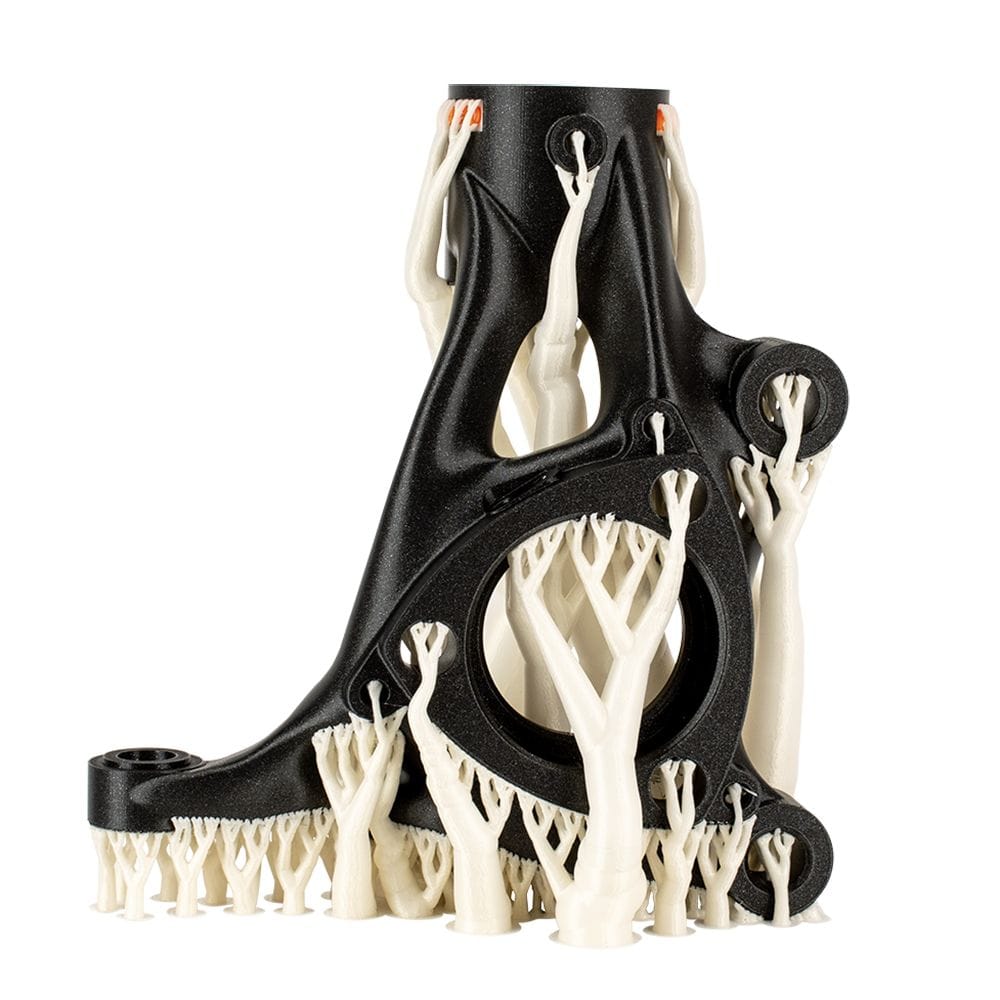
This is where the XL wins definitively — and it matters a lot for figure printing.
On a complex 4-color anime figure with frequent color changes, a Bambu X1C with AMS might generate 30–60g of purge waste per print depending on color order and model complexity. On the same model, the Prusa XL's wipe tower is significantly smaller — the tower only needs to stabilize pressure, not flush out old material. Waste drops to 5–15g in typical use.
That said, the AMS waste is not fixed: calibrating flush amounts in Bambu Studio, ordering filaments light-to-dark, and dialing the prime tower width down can reduce waste meaningfully. Experienced Bambu users often get waste into the 15–25g range. But it never reaches XL levels.
For collector/figure printing economics: If you're printing 10 multi-color figures a week, the Bambu waste adds up to real money over months. If you're printing 1–2 for fun, it's noise.
Color Capacity
The XL handles up to 5 toolheads — so max 5 colors per print. The Bambu X1C with a single AMS handles 4 colors; with 4 AMS units chained it handles up to 16 colors. The new H2C with Vortek handles 7.
For anime figure printing, 4–5 colors is the sweet spot anyway. Most characters break down into: skin tone, hair, main outfit color, accent/detail color, and eye color. Either system covers this comfortably.
Speed
Bambu wins here, and it's not close. The X1C and P1S run significantly faster print speeds than the XL, even accounting for time spent on color swaps. Bambu's acceleration and travel speed are class-leading. The XL's toolhead change adds dwell time at each swap, and Prusa's general print speeds lag behind Bambu's engineering by a meaningful margin.
For display figures (where you want maximum surface quality over speed), the gap narrows — both machines can be set to quality mode. But if you're batch printing blind box collectibles, Bambu wins on throughput.
Want more guides like this — Bambu, Prusa, Anycubic, and the rest of the FDM landscape compared with a maker's eye? Subscribe to Geeky Inc and we'll send the deep dives straight to your inbox.
Noise
The XL is louder during toolhead swaps — the physical parking and pickup sequence makes noise. In a workshop it's fine. In a home office or shared space, it's noticeable. Bambu machines (especially the X1C/P1S in an enclosure) run quieter overall.
Ecosystem and Software
Bambu: Bambu Studio is polished and actively developed. Multi-color workflow is well-integrated, slicing is fast, and the MakerWorld model library has a huge selection of pre-configured multi-color .3MF files. Firmware updates are frequent. The ecosystem is closed but reliable.
Prusa: PrusaSlicer is excellent, open-source, and widely supported. The XL's toolhead system requires careful profile management — each toolhead profile needs to be accurately calibrated, and profile switching can be finicky with third-party filaments. Open ecosystem = more flexibility, more setup work.
What About the Bambu H2D?
The H2D is Bambu's 2026 flagship and changes the conversation. Unlike the AMS — which still uses a single shared nozzle and produces purge waste — the H2D ships with true dual-extrusion: two independent hotends, each with its own filament, swapping between layers without contaminating the other. Functionally, that puts it closer to the Prusa XL philosophy than to the AMS.
For figure printing specifically, the H2D matters because it brings the "no purge between two main colors" advantage to the Bambu speed and ecosystem. You don't get the XL's full 5-toolhead capacity, and you'll still use AMS-style purge if you go beyond two materials in a single print. But for the common figure case (skin tone + hair, or body + accent), the H2D collapses one of the XL's biggest advantages.
It also costs less than a fully-equipped Prusa XL, prints faster, and slots into a Bambu workflow most makers already know. If you've been on the fence between buying an XL for waste reasons and staying with Bambu for speed, the H2D is the genuine compromise — and probably the right answer for most 2026 buyers who don't need 5+ colors.
The H2C (with Vortek) is the middle option: keeps the AMS-style approach but reduces purge waste by ~58% versus the original AMS, while sitting between the P1S and the H2D in price.
The Verdict for Anime Figure Printers
For hobbyist figure printing on a budget: P1S + AMS. Lower cost, faster prints, easier ecosystem, great MakerWorld library for pre-configured multi-color files.
For most 2026 buyers who care about waste but want Bambu speed: The H2D. Dual-extrusion gets you 80% of the XL's waste advantage at half the workflow friction.
For a small studio doing commercial figure production at high volume: Prusa XL is still worth the premium for the waste savings on 5+ color prints. At true production scale, the filament savings pay back the price difference.
If 4 colors is your ceiling and waste is your only AMS complaint: The H2C with Vortek closes the gap meaningfully without changing the workflow you already know.
More on 3D Printing at Geeky Inc
- Bambu X2D vs H2D vs H2C: Specs, Price & Best Pick (2026)
- Best Anime STL Files for 3D Printing in 2026
- Best Articulated 3D Prints: Dragons, Creatures & Fidget Toys
- 10 Cool 3D Prints from a Video Game
Printing your own anime collectibles? We cover FDM printing for the anime and gaming niche — and we're building actual printed products. Join the Geeky Inc community →
Related reading: Within the Bambu lineup itself, you have three flagships to choose from — full breakdown in our Bambu Lab H2D vs H2C vs X2D: Full Comparison (2026).
Where to Get Each System
- Bambu Lab AMS — the multi-material unit for the P1S and X1C.
- Prusa-compatible filament — feed the XL.
- Multicolor PLA multipack — works with either system.
Get Side Quest — our weekly anime + JRPG newsletter, free →
As an Amazon Associate, Geeky Inc earns from qualifying purchases.
Geeky Inc Minis
Tiny dragons, kitsune and golems for your shelf.
Multi-color 3D-printed minis, printed, finished and shipped by us. $2.50 each, or 12 for $23.
Browse the minis →


Member discussion