


Street Fighter 2 is still the most-played classic fighting game online in 2026 — and if you're coming in without knowing the inputs, you're getting bodied every round. This guide covers every character's essential Street Fighter 2 combos and special moves, a breakdown of which SF2 version to play, and the core mechanics that separate a random button-masher from someone who actually wins.
All Street Fighter 2 Combos (Quick Reference Table)
Skim this table for the highest-value combo and signature special move for every character. Notation key is right below — the inputs use standard fighting-game shorthand (s. = standing, c. = crouching, j. = jumping; →↓↘ + P = Shoryuken motion; ← / ↓ "charge" = hold that direction ~2 seconds before completing).
- Ryu — c.MK → Hadouken (↓↘→ + P) for the classic mid-range confirm; j.HK → c.HP → Shoryuken (→↓↘ + P) for max-damage jump-in punish
- Ken — j.HK → c.HP → Heavy Shoryuken (hits twice in Super Turbo, more damage than Ryu's); Shoryu Reppa Super Combo (→↓↘→↓↘ + P) for blocked-move punishes
- Guile — c.MK → Sonic Boom (← charge → + P) for mid-range pokes; j.HK → c.HP → Flash Kick (↓ charge ↑ + K) for high-damage punish — must pre-charge constantly
- Chun-Li — c.MK → Lightning Legs (rapid K) for pressure; Spinning Bird Kick (↓ charge ↑ + K) for anti-air and combo finisher — fastest pokes in the game
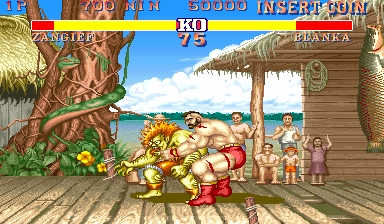
- Zangief — j.HK → SPD (360° + P) is the core gameplan; Final Atomic Buster (720° + P) Super for the biggest damage throw in the game
- Blanka — Rolling Attack (← charge → + P) for mobility and damage; Electricity (rapid P) beats throws and stuffs grab attempts
- Dhalsim — Yoga Fire (↓↘→ + P) for long-range zoning; teleport adds another layer of mind games
- E. Honda — Hundred Hand Slap (rapid P) for close-range pressure; Sumo Headbutt (← charge → + P) approaches through fireballs
- Balrog — Turn Punch (hold LP+MP, release) is the core read tool; damage scales with charge time
- Vega — Wall Dive (↓ charge ↑ + K) for long-range mobility — fastest character in the game
- Sagat — High and Low Tiger Shot (↓↘→ + P / K) cover every angle; Tiger Uppercut (→↓↘ + P) anti-airs anything that jumps
- M. Bison — Psycho Crusher (← charge → + P) for pressure through fireballs; Scissor Kick (← charge → + K) for block-string starters that build super meter
Full character breakdowns, frame data context, and the matchup mindset for each one are below. Start with the notation guide if any of those inputs look like hieroglyphics.
Easiest Street Fighter 2 Combos for Beginners
New to SF2? Drill these three first — they work in every version and build the muscle memory everything else relies on:
- Jump-in confirm — j.HK → c.MK → Hadouken (Ryu/Ken). The foundational bread-and-butter.
- Light-into-special — c.LP → c.LP → Shoryuken. Easy hit-confirm into real damage.
- Anti-air Shoryuken — →↓↘ + P as they jump in. Not a combo, but the most important habit in the game.
Move Notation Guide (Read This First)
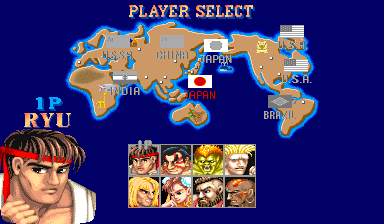
Fighting game guides use shorthand notation. Here's what everything in this article means:
- s. = Standing (on your feet)
- c. = Crouching (holding down)
- j. = Jumping (in the air)
- LP / MP / HP = Light / Medium / Heavy Punch
- LK / MK / HK = Light / Medium / Heavy Kick
- → = Combo into (land this move, then immediately do the next)
- DP = Dragon Punch (the Shoryuken rising uppercut motion: →↓↘)
- SPD = Spinning Pile Driver (Zangief's full 360° throw)
- [charge] = Hold that direction for ~2 seconds before completing the input
So c.MK → Hadouken means: throw a crouching medium kick, then immediately execute a Hadouken fireball before your character's animation fully recovers. That's a combo — both hits land before the opponent can block.
Which Version of Street Fighter II Should You Play?
There are more versions of SF2 than most people realize. Here's the quick breakdown:
- Street Fighter II: The World Warrior (1991) — The original. Eight playable characters, no mirrors, no air throws. Mostly historical at this point.
- Champion Edition (1992) — Added the four bosses as playable characters and mirror matches. A big leap over the original.
- Hyper Fighting (1992) — Faster speed, new move properties. The "turbo" era's starting point.
- Super Street Fighter II Turbo (1994) — The competitive standard. Adds Super Combos, a balanced cast, and the version most tournament players use. If you want to play SF2 seriously, this is it.
- Ultra Street Fighter II (2017, Switch) — A modern port of Super Turbo with online play and two new characters. Best way to play on modern hardware.
Bottom line: Play Super Turbo or Ultra SF2. Everything below applies to both.
Universal Mechanics You Need to Know
Before getting into characters, these fundamentals apply across the whole game:
- Normal moves — Standing, crouching, and jumping attacks. Crouching mediums (c.MK, c.MP) are the backbone of most offense because they're fast and lead into specials.
- Special moves — Quarter-circle, half-circle, or charge inputs. These are the signature abilities — fireballs, uppercuts, spinning kicks.
- Throws — Press LP+LK simultaneously next to an opponent. Untechable in SF2 — they always land if you're in range and they can't jump out.
- Dizzy — Land enough consecutive hits and your opponent gets stunned. This is when you land your biggest damage combos.
- Super Combos (Super Turbo only) — Fill the super meter at the bottom of the screen, then execute a double-motion input. Every character has one. High damage, cinematic, and often game-deciding.
- Charge characters — Guile, Balrog, Blanka, E. Honda, Vega, and Bison require holding a direction for about 2 seconds before executing their specials. You need to be charging constantly — even while moving and blocking.
Ryu — The Balanced Rushdown
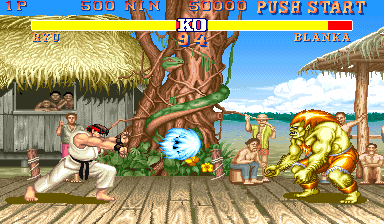
The game's "tutorial" character in practice, but a top-tier threat in the right hands. His fireball (Hadouken) controls space; his uppercut (Shoryuken) punishes jumps. Simple tools, deep mastery ceiling.
Key inputs:
- Hadouken (fireball): ↓↘→ + Punch
- Shoryuken (rising uppercut): →↓↘ + Punch
- Tatsumaki (spinning kick): ↓↙← + Kick
Core combos:
- Crouching Medium Kick → Hadouken (the classic confirm — works at mid range, safe on block if spaced)
- Jumping Heavy Kick → Crouching Heavy Punch → Shoryuken (jump-in punish combo, high damage)
- Crouching Heavy Punch → Hadouken (anti-air into fireball — use when they jump at you from distance)
Super Combo: Shakunetsu Hadouken (↓↘→↓↘→ + Punch) — a flaming close-range fireball. Best used after a jump-in or as a punish when you read a predictable move.
Ken — Ryu's Faster, Riskier Cousin
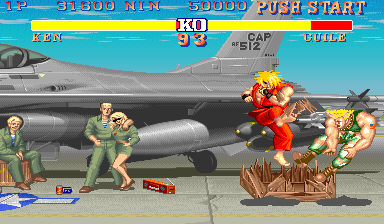
Ken plays more aggressively. His Shoryuken does more damage than Ryu's and hits multiple times in Super Turbo. His fireball is slower (less space control), but he makes up for it with stronger close-range pressure and better mix-up options.
Core combos:
- Crouching Medium Kick → Hadouken (same as Ryu, still effective)
- Jumping Heavy Kick → Crouching Heavy Punch → Heavy Shoryuken (Ken's uppercut hits twice in Super Turbo — more damage than Ryu's version)
- Crouching Heavy Punch → Light Shoryuken (safer follow-up, easier timing, consistent damage)
Super Combo: Shoryu Reppa (→↓↘→↓↘ + Punch) — a series of Shoryukens. Extremely damaging. One of the best punishes in the game if you land it after a blocked move.
Guile — Zone and Wait
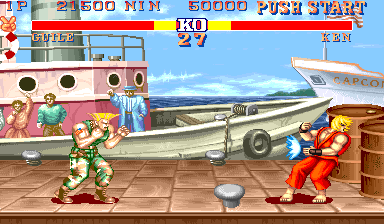
Guile is the quintessential charge character. His playstyle is simple in concept — throw Sonic Booms, anti-air with Flash Kick — and brutally difficult to crack when executed correctly. You must hold back or down constantly to keep his special moves ready.
Key inputs (must pre-charge):
- Sonic Boom (horizontal projectile): Hold ← for 2 sec, then → + Punch
- Flash Kick (rising anti-air): Hold ↓ for 2 sec, then ↑ + Kick
Core combos:
- Jumping Heavy Kick → Crouching Heavy Punch → Flash Kick (standard punish — high damage, requires pre-charge)
- Crouching Medium Kick → Sonic Boom (mid-range poke combo — safe and consistent)
- Standing Heavy Punch → Flash Kick (close-range punish when they walk into you)
Super Combo: Total Wipeout (←[charge]→←→ + Punch) — a triple Sonic Boom. Devastating at full screen. Great against opponents who rely on projectiles.
Chun-Li — Fastest Pokes in the Game
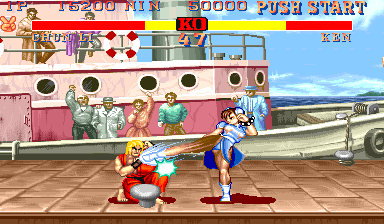
Chun-Li wins neutral with her incredible normal moves — her standing and crouching medium kicks reach farther and recover faster than almost any other character. Her combo game is secondary; her spacing game is dominant.
Key inputs:
- Kikouken (charge fireball): Hold ← for 2 sec, then → + Punch
- Lightning Legs: Rapidly tap any Kick button (6+ times fast)
- Spinning Bird Kick: Hold ↓ for 2 sec, then ↑ + Kick
Core combos:
- Crouching Medium Kick → Lightning Legs (poke into rapid kicks — classic Chun pressure string)
- Jumping Heavy Kick → Standing Heavy Punch → Spinning Bird Kick
- Crouching Heavy Punch → Kikouken
Super Combo: Kikosho (↓↘→↓↘→ + Punch) — a giant ball of ki. Best used as a punish or meaty setup after a knockdown.
Zangief — The Grappler
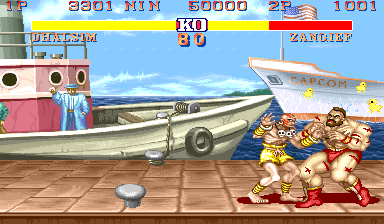
Zangief wins by getting in and landing his Spinning Pile Driver. Everything he does is designed to close distance against players who want to keep him out with fireballs and pokes. His damage payoff is the highest in the game — but his execution ceiling is also the highest.
Key inputs:
- Spinning Pile Driver (SPD): Full 360° rotation + Punch (you can start from any direction)
- Double Lariat (spinning arms): LP + LK simultaneously
Core combos:
- Jumping Heavy Kick → SPD (the core gameplan — jump in, land on them, immediately throw)
- Crouching Heavy Punch → Double Lariat (anti-fireball option at close range)
Super Combo: Final Atomic Buster (720° + Punch) — the biggest damage throw in the game. Nearly impossible to escape once you're in range.
Blanka, Dhalsim, E. Honda — The Wild Cards
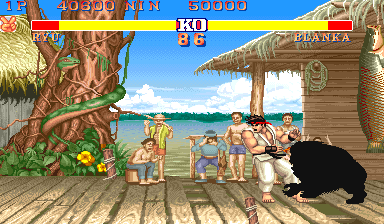
Blanka — A charge character whose Rolling Attack (hold ← then → + Punch) is his main tool. His Electricity (rapidly press Punch buttons) beats throws and stuffs opponents who try to grab him. Unpredictable and frustrating to fight if you've never seen him before.
Dhalsim — The ultimate zoner. His stretchy limb normals, slide kick, and Yoga Fire (↓↘→ + Punch) make him extremely frustrating to approach. Teleport adds another layer of mind games. His combos are basic, but his space control is oppressive.
E. Honda — Hundred Hand Slap (rapidly press Punch) creates fast close-range pressure. Sumo Headbutt (hold ← then → + Punch) is a great approach option through fireballs. Deceptively straightforward game plan that punishes players who don't know the matchup.
The Boss Characters — Balrog, Vega, Sagat, M. Bison
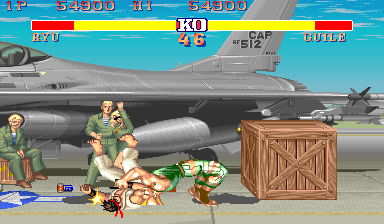
Balrog (Boxer) — All punches, no kicks, entirely charge-based. His rushing punches deal massive damage and his Turn Punch (hold LP+MP or LP+HP, then release) is a powerful read tool. Simple moveset, dangerous damage output.
Vega (Claw) — Fastest character in the game. Wall dive, long-range claw swipes, and superior footsie normals. If he loses his claw from taking damage, his normals get significantly weaker — protect the claw by playing more defensively early.
Sagat — The fireball king. High Tiger Shot and Low Tiger Shot together cover almost every angle of approach. Tiger Knee closes distance fast and Tiger Uppercut anti-airs anything. One of the top-tier picks in Super Turbo.
M. Bison (Dictator) — Psycho Crusher (a flying body slam) and Scissor Kick are his pressure tools. A charge character who can control space and attack simultaneously. His Super Combo is one of the strongest in the game at close range.
Where to Play SF2 Online in 2026
- Fightcade — Free, rollback netcode, massive player base. The gold standard for Super Turbo online. Download the client and get your ROM separately — search "Fightcade ROMs" for setup guides.
- Ultra Street Fighter II on Switch — Official, easy, online play built in. Available on the Nintendo eShop. Best option if you want a modern package without emulation setup.
- Street Fighter 30th Anniversary Collection — Available on PC (Steam), PS4, Xbox, and Switch. Includes multiple SF2 versions with online play. Good all-in-one package if you want to explore the full history.
Display your retro gaming roots. While you're perfecting your Hadouken timing, add some nostalgia to your desk. Our Jumbo Gameboy Pokemon Cartridge is a 3D-printed statement piece for anyone who grew up with a Game Boy in hand — available now in the Geeky Inc shop.
The One Skill That Wins More Rounds Than Any Combo
The single highest-leverage skill in SF2 isn't combo execution — it's understanding range. Every character has one or two normal moves that work best at a specific distance from the opponent. Learn exactly how far that move reaches. Stand at that range. Poke with it repeatedly and only when you're at the right distance. When it hits, follow up with your special move. When it misses, stay patient and reset.
For most characters, the crouching medium kick is that move. It's fast, low to the ground (harder to jump over), and connects into fireballs or specials. Once you know the range of your character's best poke, everything else in this guide starts to click.
If you want to go deeper on character matchups or specific build strategies, drop a comment below. And if you're into gaming gear and collectibles for your setup, check out the Geeky Inc shop.
Want more gaming deep-dives? Subscribe to the Geeky Inc newsletter — guides, reviews, and geek culture drops straight to your inbox.
Gear Up: Play Street Fighter II the Way It Was Meant To Be
Landing these combos consistently is far easier with hardware built for fighting games. Here's what serious players reach for:
- Street Fighter 30th Anniversary Collection — every classic version of SF2 in one package, ideal for drilling these inputs.
- 8BitDo Arcade Stick — clean charge and motion inputs that a standard pad fights you on.
- HORI Fighting Stick Alpha — Street Fighter 6 Edition (PS5) — officially licensed, tournament-grade build for PS5/PC players.
- Street Fighter 6 (PS5) — the modern entry that carries everything SF2 taught forward, with a full roster and accessible modern controls.
Get Side Quest — our weekly anime + JRPG newsletter, free →
As an Amazon Associate, Geeky Inc earns from qualifying purchases.
Wave 1 — Kitsune Legends Vol. 1
Wave 1 is live.
Four hand-printed fox-spirits. One sealed box. You don't choose your kitsune — you summon it. Limited run, no restock.
Summon your Kitsune on Etsy →


Member discussion