


If you love anime, gaming, Japanese folklore — and the idea of holding a physical version of your favorite character in your hands — 3D printing was made for you. This guide covers everything: which printer to buy, what filament to use, where to find the best STL files, how to actually print an anime figure without it looking like a melted disaster, and what to do with it once it comes off the bed. No fluff, no filler — just the complete 2026 playbook to go from zero to printing collectible-quality figures in the niche where mass-market manufacturers won't go.
Why 3D Printing and Geek Culture Are a Perfect Match
The anime, gaming, and folklore-collector communities have embraced 3D printing faster than almost any other hobby crossover. The reason is obvious: official merchandise is limited, expensive, and almost never includes the thing you actually want. 3D printing inverts all of that. Want a Buster Sword that's actually to scale? Print it. Want a set of dungeon tiles for your D&D campaign? Print them. Want every Elden Ring remembrance weapon on your desk? You know what to do.
The community of designers uploading free and paid STL files for anime, gaming, and folklore subjects is enormous and only growing. Platforms like Printables, Cults3D, and MakerWorld have thousands of creators producing character models, weapon replicas, articulated figures, yokai, and functional accessories — many of them free.
What makes the hobby particularly compelling for geek culture is the customization. You're not limited to what a manufacturer decided to produce. Want a Jujutsu Kaisen-style character in a specific pose that no official figure offers? Someone has probably modeled it. Want a kitsune yokai in a 75mm scale that no mass-market brand sells? You can have it on your desk by tonight. The gap between "I wish this existed" and "I made this" is smaller than it has ever been.
Choosing Your First 3D Printer in 2026
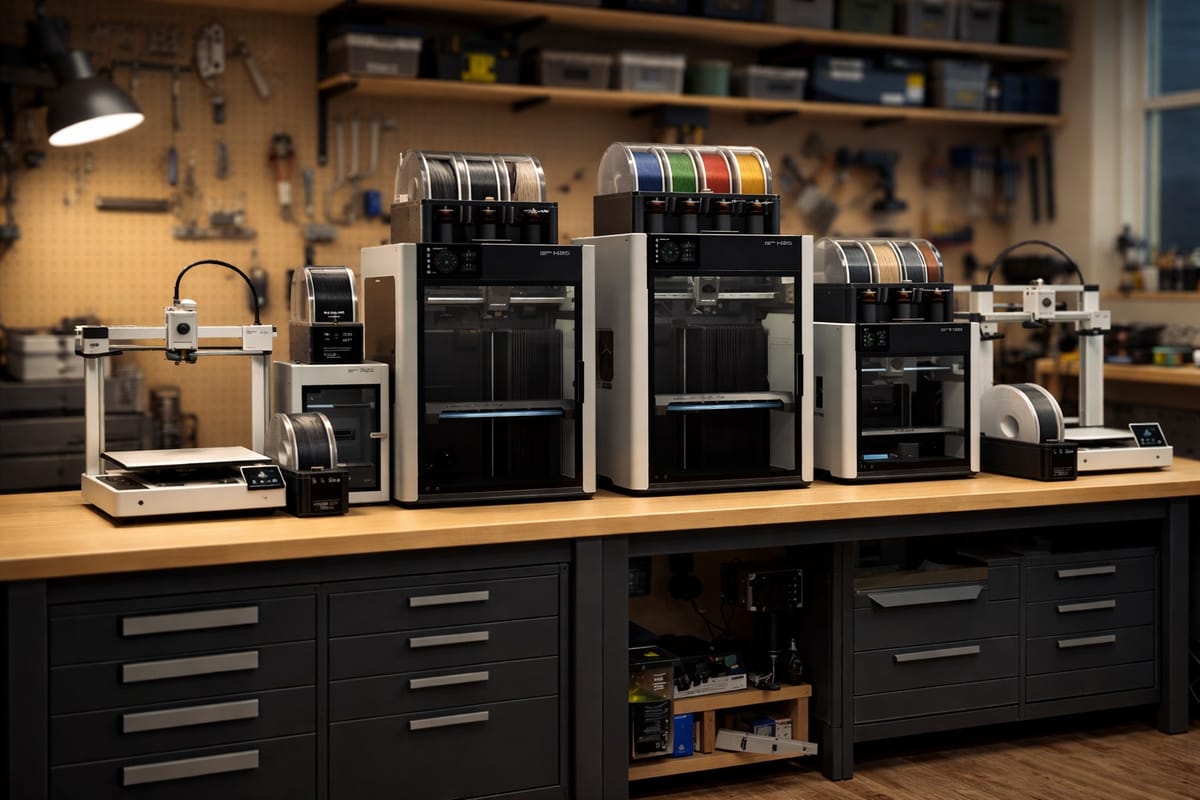
The printer market in 2026 has consolidated around a few clear winners. Here's what actually matters for figure and prop printing: bed size, ease of setup, print quality out of the box, multi-color capability, and community support when something goes wrong.
Bambu Lab A1 Mini ($300–350) — The current consensus best-in-class beginner printer. Fully automatic bed leveling, fast print speeds, and an app that actually works. If you want to skip the calibration rabbit hole and start printing within an hour of unboxing, this is the one. The multi-color AMS Lite add-on ($70) opens up polychromatic anime prints without hand-painting — print a character in full color straight off the bed. For the price, nothing else comes close to the out-of-box experience.
Bambu Lab P1S ($549) — The workhorse step up. Enclosed printing (better for ABS and engineering filaments), faster speeds, and a larger build volume. The enclosure matters if you're in a shared space (reduces noise and fumes) or printing materials that warp without temperature control. This is the printer Geeky Inc's own figures are produced on — the price-to-output ratio at this tier is unmatched.
Bambu Lab X2D ($649 standalone / $899 Combo) — Released April 2026 and already named Best 3D Printer Overall 2026 by Tom's Hardware. The X2D's killer feature is its dual-nozzle architecture: a direct-drive left nozzle paired with a Bowden right nozzle, which produces multi-material prints with 70–80% less purge waste than AMS-only setups. For studios printing two-color articulated characters at any volume, this is the upgrade that changes the unit economics. Same 256³ build volume as the P1S but adds an actively heated 65°C chamber for clean ABS and ASA. Read the full creator economics breakdown to see whether it's worth the upgrade for your use case.
Creality Ender 3 V3 SE ($150–180) — The budget entry point. Requires more manual setup and tinkering, but the community support is unmatched and the upgrade path is infinite. Good choice if you enjoy the mechanical aspect of the hobby as much as the output. The V3 SE added automatic bed leveling, which removes the single biggest frustration of earlier Enders.
Prusa MK4 ($800) — The enthusiast standard. Built in Prague, open-source, exceptional print quality, legendary customer support. Prusa's firmware and slicer (PrusaSlicer) are reference-grade tools that the entire industry benchmarks against. If you want a machine that lasts a decade with minimal maintenance, this is the investment.
Elegoo Saturn 4 Ultra ($400) — Resin — A completely different technology. Resin printers use UV light to cure liquid resin layer by layer, producing detail that FDM simply cannot match at small scales. For anime figures with fine facial features and intricate armor details, resin is the gold standard. The tradeoff: you need ventilation, gloves for handling uncured resin, and a UV curing station. Not a first printer for most people, but the right second printer if highly detailed display figures are your focus.
For most people coming from anime and gaming backgrounds: start with the Bambu A1 Mini or P1S. The A1 Mini gets out of your way so you can focus on what you're printing, not the machine itself. The P1S is the move if you know you're going past hobby into selling.
Filament 101: What to Actually Buy
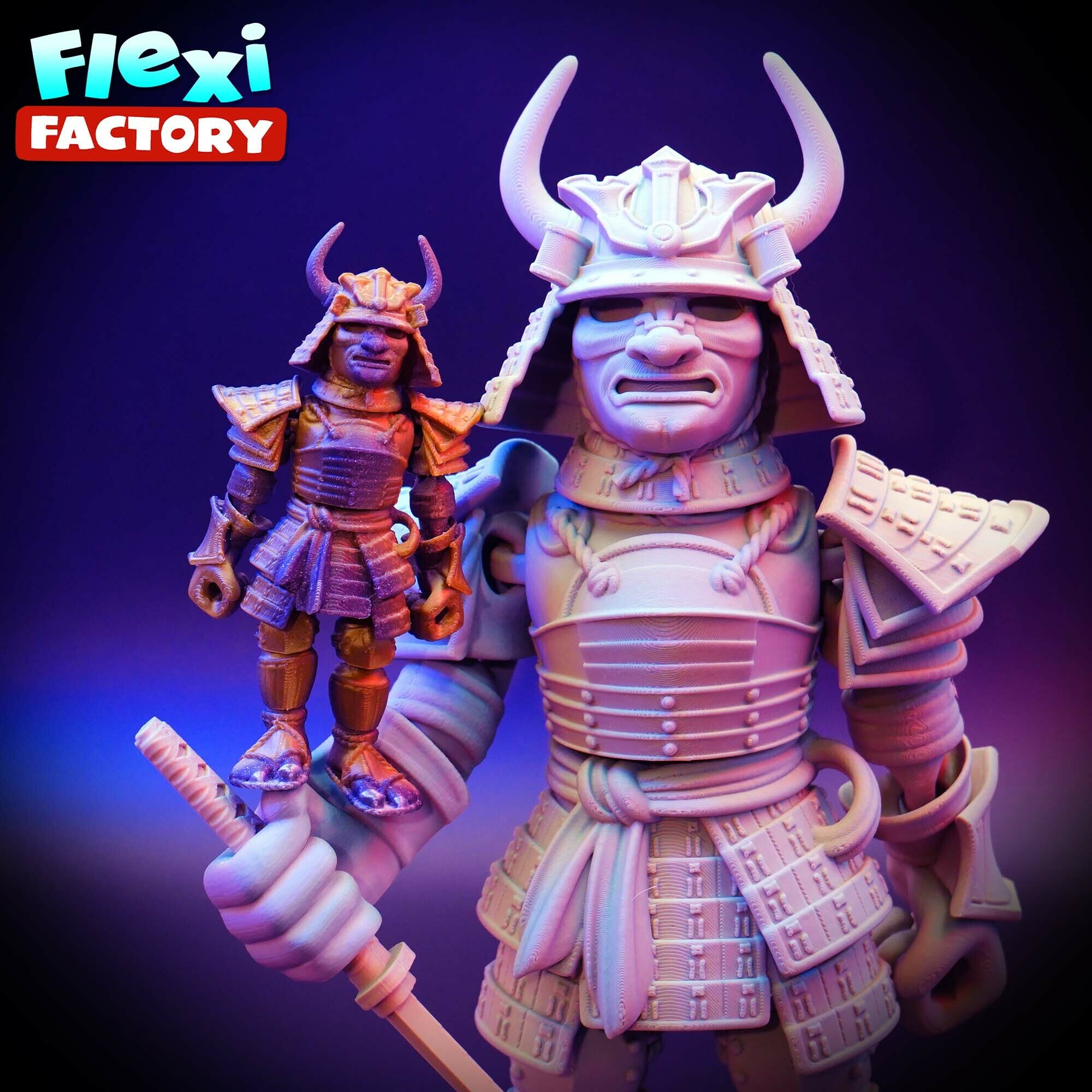
Filament is the raw material — the plastic spool your printer melts and deposits layer by layer. Choosing the right type matters more than most beginners realize, and the wrong filament for a specific print can mean the difference between a display-quality figure and a stringy, warped mess.
PLA (Polylactic Acid) — The default. Easy to print, widely available, comes in every color imaginable (including metallics, silks, and glow-in-the-dark), biodegradable, and forgiving of beginner mistakes. 95% of anime figures and gaming props are printed in PLA. It prints at low temperatures (190–220°C), doesn't require a heated enclosure, and adheres well to most build surfaces. Start here. Period. Our 3D printing troubleshooting guide covers the most common PLA issues and how to fix them.
PLA+ (Enhanced PLA) — Slightly stronger and more flexible than standard PLA, with better layer adhesion and reduced brittleness. Worth the small price premium ($2–3 more per kg) for articulated figures, moving parts, and anything that needs to handle light stress without snapping. Brands like eSUN, Sunlu, and Polymaker make excellent PLA+ at competitive prices.
PETG — More durable, slightly flexible, and significantly more heat-resistant than PLA. Good for functional parts, phone cases, and props that need to handle some wear. Slightly trickier to print (more prone to stringing, requires different retraction settings) but manageable for beginners with a few PLA prints under their belt. PETG is the step up when PLA isn't durable enough but you don't want the complexity of ABS.
ABS (Acrylonitrile Butadiene Styrene) — Strong, heat-resistant, and the gold standard for smooth post-processing. ABS can be vapor-smoothed with acetone, producing a glass-like surface finish that's stunning on anime figures. The catch: it requires an enclosed printer, good ventilation (ABS fumes are genuinely unpleasant), and careful temperature management to avoid warping. Not recommended for beginners, but once you're comfortable with the basics, the results are worth the learning curve. The X2D's actively heated chamber makes ABS dramatically more reliable than it used to be.
Specialty filaments — Silk PLA produces a gorgeous metallic sheen perfect for weapons and armor. Wood-fill PLA contains wood particles and can be stained like real wood — excellent for dungeon terrain and tabletop scenery. Glow-in-the-dark PLA makes great display pieces. Carbon fiber PLA is stiffer and more rigid, useful for structural weapon parts. These are all printed on PLA settings with visual or functional enhancements — easy to experiment with once you've dialed in basic PLA.
Best STL Sources for Anime, Gaming & Folklore Prints
The STL file — the digital model you feed to your slicer — is where it all starts. The quality of the model determines the quality of the final print more than almost any other variable. Here's where to find the best ones in 2026:
Printables (printables.com) — Prusa's platform, best-in-class quality control, massive library of free files, and an active community that rates and reviews everything. Search for any major anime title, game, or folklore subject and you'll find something printable. The community ratings system surfaces the best designs, and many creators include print settings recommendations with their files. We've curated the best anime STL platforms in detail with platform-by-platform picks.
Cults3D (cults3d.com) — Mix of free and paid. Higher concentration of professional-grade designs from creators who treat this as serious work. Strong for One Piece, Naruto, JJK-style characters, gaming weapon replicas, and a growing folklore catalog. Paid models ($3–15 typical range) tend to be more refined and print-ready than free alternatives.
MyMiniFactory (myminifactory.com) — Heavy on tabletop gaming (D&D terrain, miniatures, campaign pieces) but also a great source for gaming and anime characters. The Tribes subscription ($5/month) unlocks a rotating library of premium files — often worth it just for a single month to download a batch.
MakerWorld (makerworld.com) — Bambu Lab's own platform, growing rapidly. If you're on a Bambu printer, models from MakerWorld often come with Bambu-optimized print profiles that work out of the box. The integration is seamless — send directly to your printer from the web interface.
Thingiverse (thingiverse.com) — The original community platform, now aging. Still has an enormous archive and some files you won't find anywhere else, but search quality has declined and many older files haven't been updated for modern slicers. Worth checking for obscure requests and legacy designs.
Patreon-tier designers — A different category. Subscribing to a designer (Cinderwing3D for dragons, Zou3D for cute articulated FDM-friendly creatures, Graceful Polygons for stylized animals) gets you commercial rights, monthly drops, and access to refined catalog work. Generally $5–15/month. For anyone planning to sell prints, this is the legally-clean path.
Commissioned designs — For specific characters or original IP that doesn't exist as a free STL, commissioning a 3D modeler via Fiverr or Upwork is increasingly affordable ($50–200 for a solid character model, $200–500 for complex multi-part designs). For original IP, this is often the only path that builds a real catalog over time. Specify "print-ready" — many 3D artists create models for rendering that aren't structurally suitable for printing without modification.
Important license note: Free STL files almost always permit personal use only. Selling prints of someone else's free Thingiverse design is usually a license violation. Subscribed-designer files and commissioned originals are the right path for any print-and-sell business.
Japanese Folklore × Indie Games: A Niche Worth Printing
If you've been paying attention to indie games over the last three years — Sekiro, Ghostwire: Tokyo, Sifu, Trek to Yomi, Kunitsu-Gami, the steady drip of yokai-flavored Soulslikes — you've noticed Japanese folklore is having a sustained moment in the games industry. And the figure market hasn't caught up.
Mass-market manufacturers don't make figures of obscure yokai. They don't make figures of indie game characters. They don't make figures of the kitsune, oni, tengu, kappa, kappa-eating-kappa, or whatever else the latest hand-drawn FromSoftware-adjacent project is leaning into. There is a real, durable, underserved audience for physical objects from this aesthetic — and 3D printing is the only way to serve it without a million-unit minimum order.
What works as a 3D-printed folklore subject:
- Kitsune — fox spirits with one to nine tails. The visual variety alone (sleeping kitsune, warrior kitsune, multi-tail forms) sustains a whole product line.
- Oni — the demon warriors. Heavy-set, horned, often holding a kanabō. Prints well at scale because the silhouette is iconic.
- Tengu — long-nosed mountain spirits. The wing geometry rewards FDM articulation.
- Tanuki — shape-shifting raccoon dogs. Cute-leaning, plays well in chibi style.
- Yurei — the white-robed ghosts. Translucent or glow-in-the-dark filament does the entire job.
- Kappa — water imps with the famous head dish. Articulated print-in-place models work especially well.
The trick is treating this lane as its own product category, not as a footnote to "anime figures." The folklore audience overlaps heavily with JRPG fans, Soulslike players, and anyone who reads Mononoke-style manga — but it has its own search behavior, its own buying triggers, and its own unmet demand.
This is the lane Geeky Inc sits in: anime aesthetic, gaming-influenced design language, with characters drawing from Japanese folklore mythology rather than borrowing from established franchise IP. More on that below.
Printing Anime Figures: What Actually Works

Anime and folklore figures have specific challenges that test printers more than most objects: thin hair strands, delicate clothing folds, complex color separations, and small facial features where a 0.1mm error is immediately visible. Here's what the community has learned about getting these right.
Orientation is everything. Always orient a figure so the flat bottom (feet, base, or largest flat surface) is on the bed and the fine details (hair tips, weapon edges, outstretched fingers) are at the top. This minimizes the amount of support material touching detailed surfaces and reduces the cleanup needed after printing. A figure oriented on its back will have support scarring across the face — oriented standing up, the support scars are hidden on the undersides.
Tree supports over normal supports. Modern slicers (Bambu Studio, Orca Slicer, PrusaSlicer) all offer tree supports that grow from the build plate and branch upward to contact the print at minimal points. For anime and folklore figures, these are non-negotiable. They snap off cleanly, leave far less scarring than traditional grid supports, and use less material.
Layer height for detail: 0.12mm or lower. Standard 0.20mm layer height is fine for props and scenery. For figure faces, hair, and fine clothing detail, drop to 0.12mm. For resin-level detail on FDM, push to 0.08mm (print time increases dramatically but the surface quality approaches what resin produces at much lower cost).
Multi-part printing for color separation. Rather than painting an entire figure, many designers split their models into parts corresponding to different colors — body in one color, hair in another, weapon in a third. Print each part in the final color, then assemble. CA glue (gel formula) is the standard adhesive; CA activator spray helps with instant bonding on tricky joints.
Post-processing changes everything. Even a well-printed figure benefits from sanding (start 220 grit, work to 800+), a coat of filler primer, and careful painting with acrylic brushes or airbrush. If painting isn't your thing, a clear coat (matte or gloss) over the bare print still dramatically improves the look by hiding layer lines. Our guide to improving 3D print quality goes deep on post-processing.
Gaming Props and Weapons: A Different Set of Rules
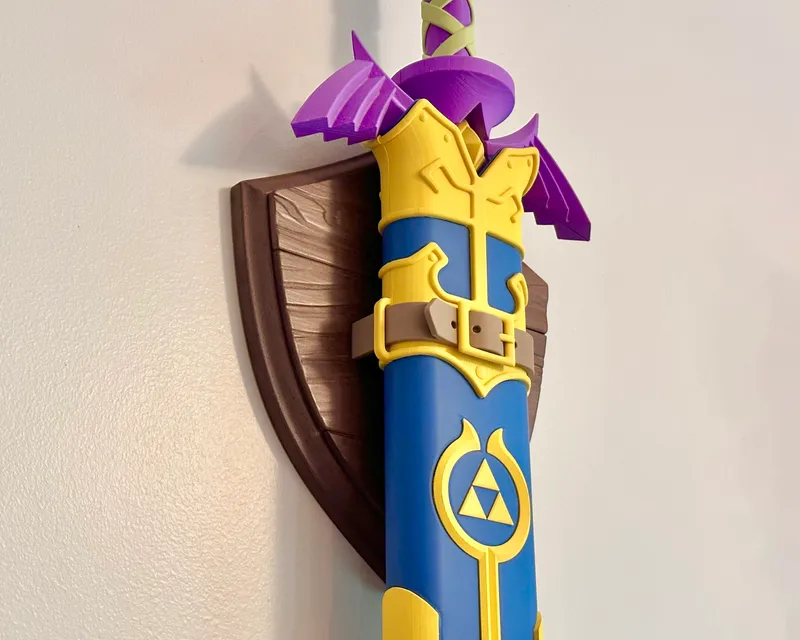
Gaming weapons — Buster Sword, Master Sword, Skyrim Dragonbone weapons, Elden Ring remembrance weapons, Keyblade — are a different beast from figures. They're large, often require multiple parts joined together, and need to be structurally sound enough for display, light handling, or cosplay.
Print in segments. Any weapon over 200mm (about 8 inches) will need to be printed in pieces and joined. The join point matters for structural integrity — design or find files where the seam falls at a natural visual break (a crossguard, a blade section, a hilt cap).
Infill percentage: Standard figures can print at 10–15% infill. Weapons and props you'll handle should be 20–30%. Full-size cosplay weapons that need to survive a convention: 30–40%. The difference in filament cost is minimal; the difference in durability is significant. For very long weapons (katanas, greatswords), consider a hollow print with a wooden dowel or aluminum rod inserted through the center for rigidity.
PLA+ or PETG for anything handled. Standard PLA is brittle under stress and will snap at thin cross-sections if dropped or flexed. If a prop is going to be held, posed for photos, or displayed where it could fall, the upgrade to PLA+ or PETG is worth it. For cosplay props that need to survive being worn and handled for hours, PETG is the minimum.
For the deeper dive into specific anime weapon files: our roundup of iconic anime weapons includes which ones are 3D printable and where to find the files.
Articulated Prints: The Coolest Thing You Can Print Right Now
Print-in-place articulated models — dragons, creatures, fidget toys, and now full character figures that move straight off the print bed with no assembly — are having a sustained moment. They're genuinely impressive, make great gifts, and show off what 3D printing can do that no other manufacturing process can match.
The key to successful articulated prints is layer adhesion and tolerance. The joints work because the printer deposits layers with microscopic gaps between interlocking parts. Too much tolerance and the joints are floppy; too little and they fuse together. Most articulated designs are tested and calibrated for specific printers and settings — follow the designer's recommended settings exactly for your first print, then adjust from there.
The crystal dragon (CinderellaCB on Printables) is the community's gateway drug — millions of downloads and counting. From there: articulated phoenix, mech suits, octopi, and increasingly complex character designs that border on mechanical engineering. Our guide to the best articulated prints covers the top designs and how to print them successfully.
3D Printed Board Game and Tabletop Accessories
The tabletop RPG community's adoption of 3D printing is complete at this point. Dungeon tiles (the OpenForge system is the community standard — modular, free, and infinitely expandable), miniature bases, storage inserts for board games (search "[board game name] insert" on any STL platform), custom dice towers, and campaign-specific terrain — all of it is printable, all of it is better than anything you can buy at retail for the price.
For Dungeon Masters: HeroForge (heroforge.com) lets you design custom miniatures in a web-based tool and export the STL for home printing. Design your party's exact characters — race, class, equipment, pose — and print them on your resin printer for pennies per mini instead of $8–15 for a pre-made figure. Our tabletop guide is the deep dive on this specific use case.
Getting Started: Your First Two Weeks
- Day 1: Unbox, run auto-calibration (Bambu handles this automatically), print the included test model. Observe the process. Understand what you're looking at.
- Day 2: Download Orca Slicer (free, best for beginners, works with all printers). Print a calibration cube. Check dimensions with digital calipers — you want 20mm ± 0.2mm on each axis.
- Day 3: Download a simple anime chibi figure from Printables (search "chibi anime" and sort by popularity). Print at 0.16mm layer height. Get your first display-worthy win.
- Day 4–5: Try your first multi-part print. Pick a weapon or a figure with a separate base. Practice gluing parts together cleanly.
- Day 6–7: Experiment with tree supports on a figure with overhangs. This is where you learn the relationship between support settings and surface quality.
- Week 2: Post-process your best print — sand it, prime it, consider painting. Try a different filament color or type (silk PLA is a satisfying upgrade). Download something ambitious: a full-size weapon part, a multi-color figure, or an articulated dragon. Begin your first proper print start to finish with intention.
Geeky Inc Case Study: Finding the Niche
Geeky Inc started with a single Bambu Lab P1S, the question of where the underserved figure niche actually was, and a hunch that the audience for anime-aesthetic figures rooted in Japanese folklore was bigger than the merchandise industry was acknowledging. That hunch became a line of articulated print-in-place figures built around Shiro, an original character rooted in that folklore.
Three lessons from the build that anyone going from "I print figures" to "I sell figures" should internalize:
- Pick a niche that has search behavior but no merchandise. Anime figures broadly is over-served. Anime-aesthetic figures rooted in Japanese folklore is not. Folklore-flavored indie game characters is not. The narrower lane is where a one-person studio actually wins.
- Articulation is the moat. A static printed figure looks like a 3D-printed figure. An articulated print-in-place figure feels like a real toy. The hardware (Bambu) and the design work (Zou3D-style designers, custom commissions) make this accessible at a price most studios can't match with mass-manufacturing.
- Pack format multiplies perceived value. A single figure for $15 reads as overpriced. A blind pack at $15 with a 1-in-N chase variant reads as a collectible drop. Same physical object, different framing, very different conversion.
The X2D is the upgrade for two-color humanoid warrior characters — the dual-nozzle architecture lets the contrasting accent colors define the visual identity without burning half the filament budget on a purge tower.
The Community
Reddit's r/3Dprinting (5M+ members) is the fastest way to get help on any print issue — post a photo of a failed print and someone will diagnose the problem within an hour. r/PrintedMinis specializes in tabletop gaming miniatures. r/AnimeStatues has a growing 3D-printed section.
The Bambu Lab community Discord is exceptionally active for Bambu users and has dedicated channels for anime, gaming, and cosplay prints. YouTube channels like Maker's Muse, Lost in Tech, and Uncle Jessy cover beginner techniques, filament reviews, and project builds in depth. CNC Kitchen provides the most rigorous material testing content for anyone who wants to understand why different filaments behave differently.
What's Coming: The Future of Figure 3D Printing
Multi-material printing took a major step forward in April 2026 with the launch of the Bambu X2D — the first sub-$700 printer with a true dual-nozzle architecture. Combined with maturing AMS systems and the Prusa MMU3, the path from "I want this character in four colors" to "this character printed in four colors straight off the bed" is shorter and cheaper than at any previous point.
AI-assisted model generation is starting to make it possible to generate printable STL files from reference images — tools like Meshy, Tripo, Kaedim, and Luma AI can take a character image and produce a 3D model that, while not yet print-ready in most cases, is rapidly improving. Within a year or two, the workflow "screenshot → print-ready model" will be functional for basic figures.
And collector culture is crossing into 3D printing in new ways — indie creators are designing limited-edition figure lines specifically for physical production, combining the accessibility of 3D printing with the exclusivity of collector markets. Geeky Inc is building in that space too. There will be many more.
Frequently Asked Questions
What's the cheapest 3D printer that prints anime figures well in 2026? The Bambu Lab A1 Mini at $300–350 is the consensus best entry-level printer for figure work. It produces display-quality output out of the box, with optional multi-color via the AMS Lite. If you're truly minimum-budget, the Creality Ender 3 V3 SE works but requires more tinkering.
Do I need an AMS to print multi-color figures? No, but an AMS or AMS Lite changes the workflow significantly. Without one you're doing manual color swaps at layer changes (slow, but free) or printing in multiple parts and assembling. With an AMS you get automated 4–16 color changes mid-print at the cost of some filament waste in purge towers. The Bambu X2D's dual-nozzle setup is the new option that reduces that waste by 70–80%.
Can I sell prints of free Thingiverse models? Almost always no. Most free STL files carry licenses that permit personal use only — selling printed copies violates the license. The clean path for selling is to subscribe to Patreon-tier designers who grant commercial rights, or commission original models that you own outright.
Resin or FDM for anime figures? Resin produces finer detail at small scales — facial features, intricate hair, delicate armor. FDM is cheaper to run, doesn't require ventilation or PPE, and (with filament choices like PLA Matte) approaches resin quality on figures 75mm and larger. Most studios run both: FDM for production volume, resin for premium display pieces.
How long does an articulated chibi figure take to print? On a Bambu P1S at default 0.16mm layer height, a typical 80mm articulated chibi takes 4–6 hours. At 0.12mm for higher detail, expect 6–9 hours. The X2D speeds single-color prints meaningfully but multi-color prints are still gated by the right (Bowden) nozzle's 200 mm/s ceiling.
What if I want to design my own original figures? For most makers, commissioning is faster and cheaper than learning to model from scratch. Fiverr or Upwork for $50–200 per character (specify "print-ready" and "full commercial rights"). For learning to model: Blender (free) is the industry standard; Nomad Sculpt (iPad) is the easiest entry point for character work; Tinkercad (browser) for simple geometric props.
Is Bambu Lab the only good option in 2026? Bambu currently dominates the prosumer figure-printing tier on out-of-box experience and community traction. Prusa is the long-term-quality alternative. Creality covers the budget end. For figures specifically, Bambu's combination of speed, multi-color, and refinement is hard to match — but the printer market evolves fast and competition is real.
Where do I sell 3D-printed figures once I'm making them? Etsy is the marketplace default but takes meaningful fees and surrounds you with competitors. Shopify is a stronger brand-build path if you're building a real product line. Geeky Inc sells on Shopify for exactly that reason.
Folklore on your desk, no printer required. We print our own — the Mini Baby Kitsune, the Mini Baby Celestial Dragon, and the rest of the Minis & Bundles collection, from $2.50 each.
Image credits: Bambu Lab official press, Tom's Hardware X2D review, and Geeky Inc original photography.
Wave 1 — Kitsune Legends Vol. 1
Wave 1 is live.
Four hand-printed fox-spirits. One sealed box. You don't choose your kitsune — you summon it. Limited run, no restock.
Summon your Kitsune on Etsy →


Member discussion